BONO REGIONAL MINISTER ATTENDS 18TH CONGREGATION OF SUNYANI TECHNICAL UNIVERSITY
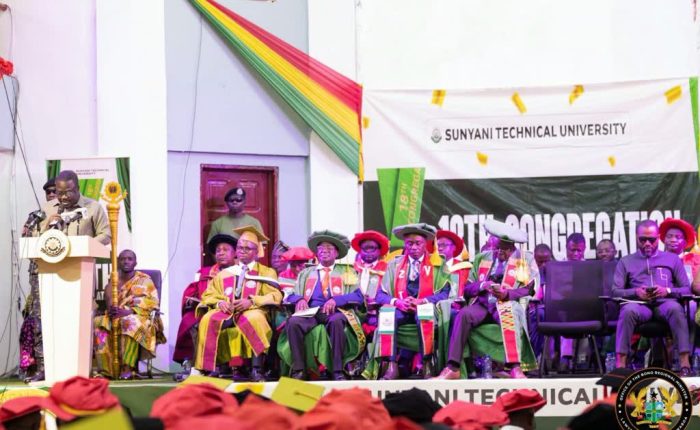
On 12th December 2025, the Bono Regional Minister, Hon. Joseph Addae Akwaboa, attended the 18th Congregation ceremony of Sunyani Technical University (STU), marking an important milestone in the institution’s development.
Speaking at the ceremony held on STU’s Sunyani campus, the Regional Minister noted that workforce development should extend beyond the acquisition of employable skills to include the cultivation of a mindset that promotes continuous learning, innovation, and long-term adaptability.
The ceremony was held under the theme “Sustainable Skills Development for Global Job Creation and Employability.” A total of 1,896 students graduated during the ceremony for the 2024/2025 academic year.
The Regional Minister observed that the complexities of the 21st century have exposed the limitations of traditional approaches to education and skills development. He explained that sustainable skills—those that enhance employability while also supporting environmental sustainability and societal well-being—are increasingly essential in today’s global labour market.

He identified areas such as renewable energy, data analysis, artificial intelligence, creativity, science, technology, engineering and mathematics (STEM), and innovation as critical components of sustainable skills development.
According to the Minister, the integration of these competencies is no longer optional but necessary for global job creation and employability.
Hon. Akwaboa also acknowledged that graduate unemployment remains a major challenge in Ghana, despite ongoing efforts to address the issue. He referenced government interventions including the National Youth Employment Programme, the National Entrepreneurship and Innovation Programme (NEIP), and the recently launched Coders Programme as measures aimed at improving employment outcomes for graduates.
In a related address, the Chairman of the STU Council, Professor Samuel Awuah-Nyamekye, highlighted staffing challenges facing the university. He explained that a combination of retirements and the introduction of new academic programmes has contributed to a high student-to-lecturer ratio, exceeding benchmarks set by the Ghana Tertiary Education Commission (GTEC).
Professor Awuah-Nyamekye disclosed that the university has submitted a request through GTEC for government approval and financial clearance to recruit additional academic staff, noting that the recruitment is critical to enabling the institution to effectively deliver on its academic mandate.


Top Management
-

- Hon. Joseph Addae Akwaboa (RM)
-

- Mr. Nar-ire P. David (Ag. RCD)
Photo Gallery